
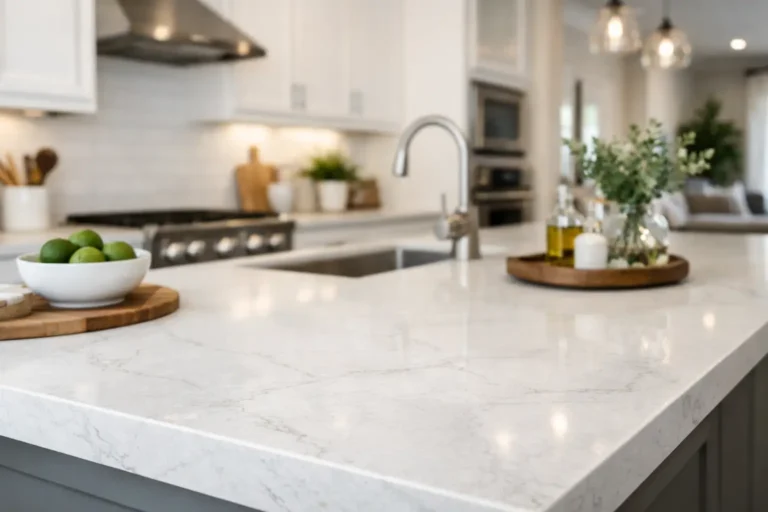
A beautiful kitchen countertop has to do more than look good under showroom lighting. It has to handle rushed breakfasts, homework, hot pans set down without thinking, and the occasional spill that sits longer than it should. This quartz countertop review looks at how the material performs in real kitchens, where its strengths are clear and its limitations deserve honest consideration.
Quartz remains one of the most requested countertop materials for kitchen renovations because it offers a refined appearance with less routine maintenance than many natural stones. That does not make it the right choice for every home. The best countertop is the one that fits how your family cooks, cleans, entertains, and uses the space every day.
Quartz Countertop Review: What You Are Getting
Quartz countertops are engineered stone surfaces. They are typically made with a high percentage of crushed natural quartz combined with resins, pigments, and binders. The mixture is pressed into slabs, then cut and finished to fit the kitchen.
That manufacturing process gives quartz a major advantage: consistency. If you choose a softly veined white surface, a warm concrete-look gray, or a dramatic dark slab, you can usually expect more predictable color and pattern from one area to the next than you would with a natural stone. For homeowners designing around cabinet samples, flooring, backsplash tile, and paint, that predictability can make decisions easier.
Quartz is sometimes confused with quartzite, but they are not the same. Quartzite is a natural stone cut from the earth. Quartz is engineered. Both can be beautiful, but they behave differently and need to be evaluated on their own terms.
Where Quartz Performs Well
Daily durability
Quartz is a hard, dense surface that stands up well to normal kitchen use. It resists scratches better than many countertop options, which is useful in active households where keys, dishes, serving trays, and small appliances move across the counter often.
Still, scratch-resistant does not mean indestructible. Knives can dull quickly on quartz and may leave marks if used directly on the surface. A cutting board remains the better choice for both the counter and your knives. Heavy cast-iron cookware, abrasive scrubbers, and dragging rough-bottomed appliances can also cause damage over time.
Easy cleaning and stain resistance
For many homeowners, this is quartz’s strongest selling point. The surface is nonporous, so it does not need the regular sealing associated with some natural stone countertops. Most everyday messes can be handled with a soft cloth, warm water, and mild soap.
Its low absorption rate also helps with common kitchen stains from coffee, wine, cooking oil, juice, and sauces. That makes quartz especially appealing for families who want a polished kitchen without adding a detailed maintenance task to the calendar.
The practical distinction matters: low maintenance is not the same as no maintenance. Strong chemical cleaners, paint removers, oven cleaners, and highly alkaline or acidic products can affect the resin and leave dull areas. Clean spills promptly, use gentle products, and avoid treating the countertop as a workbench for chemical-heavy projects.
Design flexibility
Quartz offers a wide range of looks, from quiet solid colors to patterns that resemble marble, limestone, terrazzo, or concrete. This can help create a high-end result while keeping the kitchen practical for everyday use.
If you love the soft veining of marble but do not want to worry about etching from lemon juice or wine, a marble-look quartz can be a sensible compromise. The pattern will not have the exact depth or one-of-a-kind movement of natural marble, but many modern designs are convincing and easier to live with.
The Trade-Offs Homeowners Should Know
Heat is quartz’s weak spot
Quartz handles normal room temperatures and warm dishes well, but it is not a surface for direct high heat. The resins that bind the stone can be damaged by a very hot pot, pan, electric griddle, or slow cooker. In some cases, sudden heat can cause discoloration or cracking.
This does not mean quartz is impractical in a kitchen. It means trivets should be part of the routine. If you regularly move cookware straight from the stove or oven to the counter, a heat-tolerant natural stone, stainless steel, or another surface may deserve a closer look.
Seams still exist
Large kitchen islands and long runs of cabinetry often require more than one slab. When that happens, fabricators create seams. A careful layout and skilled installation can make seams discreet, especially in patterns with movement, but they will not disappear entirely.
This is worth discussing early, before the slab is ordered. The size of the kitchen, the chosen pattern, the location of a sink or cooktop, and the available slab dimensions all affect seam placement. A good plan aims to keep seams away from the most visible work areas whenever possible.
It can be expensive
Quartz is generally a premium countertop material. The final cost depends on the slab collection, thickness, edge detail, cutouts, backsplash requirements, demolition, plumbing coordination, and the complexity of the installation. A simple perimeter counter with a standard edge will price differently from a large waterfall island with an undermount sink and multiple cutouts.
It is tempting to compare only the price per square foot, but that rarely tells the whole story. Fabrication quality, accurate templating, cabinet readiness, support for overhangs, and professional installation have a major effect on the finished result. A lower initial quote can become less attractive if important site work or finishing details are left out.
What to Check Before Choosing a Slab
A quartz countertop review is most useful when it moves beyond the sample board. A small showroom sample may not show how bold veining repeats across a full island or how a pale color reads next to your cabinet finish. Whenever possible, view the full slab or a large-format sample under lighting similar to your kitchen.
Pay attention to the finish as well. Polished quartz reflects light and often makes colors look more saturated. Honed or matte finishes can feel softer and more contemporary, although they may show fingerprints, oil, or smudges more easily depending on the color. Dark matte surfaces, in particular, are worth testing with a damp hand and a small amount of cooking oil before making a final decision.
Also consider the edge profile. A simple eased edge works in nearly any kitchen and keeps the focus on the material. More decorative edges can suit traditional spaces, while a thick mitered edge creates a substantial look without requiring an unusually thick slab. The right choice depends on cabinet style, budget, and how formal or streamlined you want the kitchen to feel.
Installation Quality Matters as Much as the Material
A quartz slab is heavy and unforgiving of poor preparation. Cabinets must be level, securely installed, and capable of supporting the countertop. Large overhangs for seating may require hidden steel or other structural support. Sink cutouts and cooktop openings need precise fabrication, particularly near corners where stress can concentrate.
Professional handling is also a safety issue. Cutting engineered stone can create respirable silica dust, so fabricators and installers need appropriate cutting methods, dust controls, and site practices. Homeowners should not treat countertop installation as a casual do-it-yourself project.
In a full kitchen renovation, countertop measurements are normally taken after cabinets are installed and secured. That sequence protects the fit of the finished surface and gives the installer accurate information for walls that may not be perfectly straight. It can feel like an extra step in the schedule, but it prevents costly surprises.
Is Quartz the Right Countertop for Your Kitchen?
Quartz is an excellent fit for homeowners who want a durable, stylish, low-maintenance countertop and are willing to use trivets for high heat. It works particularly well in busy kitchens where easy cleanup and a consistent design are priorities.
It may be less ideal if your priority is the completely natural character of quarried stone, if you often place hot cookware directly on the counter, or if you want the lowest possible upfront cost. In those cases, granite, quartzite, laminate, porcelain, or solid surface may better match your expectations.
The strongest kitchen designs do not choose materials in isolation. Bring together cabinet doors, backsplash samples, flooring, hardware, and countertop options before committing. When the surface supports the way your household actually lives, it will feel like a worthwhile part of the renovation long after the first reveal.
