
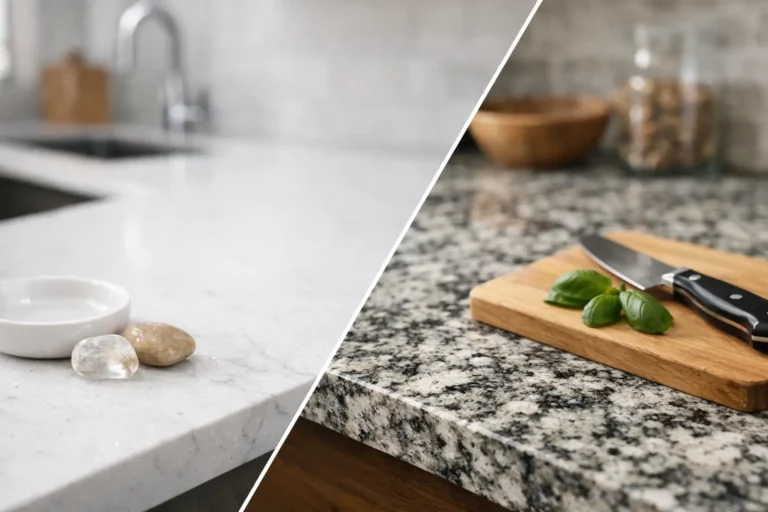
The countertop decision often becomes real when homeowners are standing in a showroom, looking at a dramatic slab of granite beside a clean, consistent quartz sample. In the discussion of quartz versus granite countertops, there is no universal winner. The right choice comes down to how your family uses the kitchen, the look you want to achieve, your comfort with maintenance, and where you want to invest your renovation budget.
Both materials can create a beautiful, high-performing kitchen. The key is choosing the one that will still feel right after years of weekday meals, school projects, entertaining, and everyday cleanup.
Quartz Versus Granite Countertops: The Core Difference
Granite is a natural stone quarried from the earth and cut into slabs. Each slab has its own pattern, movement, mineral deposits, and color variation. Even two slabs from the same quarry can look noticeably different, which is exactly what many homeowners love about it.
Quartz countertops are engineered surfaces. They are made from crushed natural quartz combined with resins, pigments, and binding materials, then manufactured into durable slabs. This process allows for more consistent color and patterning, including designs that resemble marble, concrete, or natural stone.
In practical terms, granite offers one-of-a-kind character, while quartz offers controlled consistency. Neither is inherently more stylish. A bold granite slab can become the centerpiece of a traditional or transitional kitchen, while a soft quartz surface can give a modern kitchen a calm, polished appearance.
Durability for Everyday Kitchen Use
A kitchen countertop has to handle much more than it shows in a design photo. It needs to stand up to dropped utensils, busy cooking routines, groceries, kids doing homework, and the occasional rushed cleanup.
Quartz is exceptionally hard and resistant to scratches. Its nonporous construction also makes it highly resistant to stains from common kitchen spills such as coffee, oil, wine, and juice. Because the surface does not need sealing, it is a particularly practical choice for homeowners who want a low-maintenance kitchen without giving up a refined look.
Granite is also a tough countertop material and handles normal kitchen use very well. It is naturally heat resistant, which means it tolerates hot cookware better than quartz. However, a trivet is still the smart choice for any countertop. Granite can chip at exposed edges or corners if struck hard, and its porous structure means it should be professionally sealed and resealed as needed.
Quartz can also chip under a sharp impact, especially around a sink cutout or a thin edge profile. It is not indestructible, and it is less tolerant of direct high heat. Setting a hot pan straight from the oven onto quartz can damage the resin within the material or leave a permanent mark. For families who cook frequently, heat protection should become a simple kitchen habit.
Maintenance: The Difference You Will Notice Most
For many homeowners, maintenance is the deciding factor between quartz and granite.
Quartz is easy to care for. A soft cloth, warm water, and mild soap are usually enough for daily cleaning. Since it is nonporous, there is no need for routine sealing. Avoid harsh chemicals, abrasive scrubbers, and aggressive cleaners, as they can dull the finish or affect the resin over time.
Granite needs a little more attention, but that does not make it difficult to own. Once properly sealed, it is straightforward to clean with a stone-safe cleaner or mild soap and water. The important step is staying on top of resealing, which may be needed every year or every few years depending on the specific stone, sealant, and household use.
If you want a countertop that asks very little of you, quartz is usually the better fit. If you appreciate natural materials and do not mind occasional upkeep, granite remains a dependable choice with lasting appeal.
Appearance and Design Flexibility
Your countertop does more than provide a work surface. It sets the visual direction for cabinetry, backsplash, flooring, lighting, and hardware. Choosing it early in a kitchen remodel often makes the rest of the design process easier.
Granite offers organic depth that cannot be duplicated exactly. Some slabs have subtle movement and neutral tones, while others feature dramatic veining, sparkling mineral flecks, or rich colors. Because the material varies naturally, viewing the full slab before final approval is essential. A small showroom sample cannot show the complete pattern or range of color in the installed countertop.
Quartz provides a broader range of predictable looks. It is available in crisp whites, warm neutrals, charcoal tones, soft veining, and patterns designed to resemble marble. That consistency can be helpful when you want a clean, coordinated kitchen, especially with large islands or waterfall edges where a controlled pattern matters.
For a bright, contemporary kitchen, a lightly veined quartz often pairs well with painted cabinets and simple hardware. For a warmer, more natural design, granite can add texture and character that keeps the space from feeling too uniform. The best option is the one that supports the overall design rather than competing with it.
A note about natural variation
Homeowners sometimes choose granite for its individuality, then worry when they see a variation in color or veining. That variation is not a flaw. It is part of what makes natural stone special. Still, it needs to be planned for carefully. Vein direction, seams, edge details, and the placement of the most dramatic areas of a slab should all be discussed before fabrication.
Cost and Long-Term Value
Both quartz and granite come in a wide range of price points. The final installed cost depends on the specific slab, thickness, edge profile, layout complexity, cutouts, backsplash requirements, and installation conditions. A simple countertop layout with a standard edge will cost less than a large island with waterfall panels, multiple seams, and an undermount sink.
Entry-level granite may be more affordable than premium quartz, but high-end granite can cost as much as or more than many quartz options. It is better to compare actual installed quotes for the particular materials you like than to assume one category is always less expensive.
From a resale perspective, both materials are attractive features in a renovated kitchen. Buyers generally respond well to durable, well-installed countertops that complement the cabinets and the home’s overall style. A countertop that looks appropriate for the kitchen will add more value than an expensive material chosen without regard for the design around it.
Which Countertop Fits Your Household?
Quartz is often the practical choice for busy households that want easy cleaning, stain resistance, and a consistent appearance. It works especially well for homeowners who prefer a polished, modern look and do not want to think about sealing their countertops.
Granite can be the better choice for homeowners drawn to authentic natural stone, distinctive patterns, and strong heat resistance. It is also a great fit when you want the kitchen to feel layered, warm, and truly individual.
Consider how you use the room. If your kitchen is the center of constant activity and you want the simplest possible care routine, quartz may make daily life easier. If cooking with high heat is common and you value a surface with natural movement, granite may feel more rewarding over time.
Get the Installation Details Right
The material matters, but so does the quality of planning and installation. Accurate measurements, proper cabinet support, well-placed seams, clean sink cutouts, and careful finishing at walls and backsplashes all affect the final result.
Before committing to either surface, ask to see a full slab or large sample, not only a small swatch. Confirm the edge profile, overhang support needs, sink style, seam locations, and how the countertop will meet the backsplash. These details are where a kitchen begins to feel thoughtfully finished rather than simply updated.
At HB Renovations, we help homeowners weigh these choices in the context of the entire kitchen, not as an isolated material decision. A countertop should suit the way you live, support your budget, and feel like a natural part of your home for years to come.
The best next step is to narrow your choices to a few surfaces you genuinely like, then see them alongside your cabinet color, flooring, and backsplash selections. The right countertop is the one that makes your kitchen easier to use and more enjoyable to come home to.
